

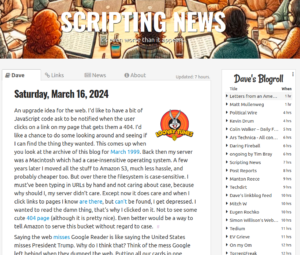
Dave Winer is doing his best to revive an early blogging tradition — the blogroll.
He’s innovated (again) in doing it, with features that show how recently a site he follows has been updated; links that open up to give you a thumbnail of text; and more. Really good stuff.
Update: He’s working with WordPress in a way that will bring what he’s doing to a huge number of people. Yes!
I need to figure out how to do it here.
As I noted in an earlier recent post, returning to blogging in a more serious way is grossly overdue, and I have people like Dave to thank for the impetus.
I’ll still be posting a lot at Mastodon, where I went after the increasingly evil owner of Twitter left me with no honorable alternative but to stop supporting his business. Mastodon is part of the distributed, open-source world of media that I strongly believe we need to re-embrace before it’s too late to avoid living solely in the clutches of monopolists and control freaks.
But this is my home base. It has been a reference site, for practical purposes. Now, I’m glad to say, it’s going to be a home base in a more purposeful way.
Discover more from Dan Gillmor
Subscribe to get the latest posts sent to your email.
Dan, good luck trying to recapture the glory days, and it may even work for you. But the bogosphere was a con job for *almost* everyone even at its peak, and the world has gotten much harsher now.
By the way, it’s interesting that the site formerly known as Twitter was apparently completely morally acceptable through many years of being modern bloodsport. Longstanding daily practice was (as is!) to take some usually hapless person having a bad day, or who simply had the misfortune to be filmed in a negative way, and dogpile on them with a howling mob of hatred – sometimes getting them fired or worse. But apparently that wasn’t so immoral as to condemn any participation in the site. I never thought the conceit in Shirley Jackson’s famous story “The Lottery” was reasonable until Twitter. It makes one understand how Romans could go to the Colosseum for the entertainment of watching gladiators kill each other. But if the Colosseum came to be owned by Elonius Muskius – oh, the humanity, the horror, how can moral people be present in such a place at all?
And Mastodon is hardly the antithesis of “control freaks”, Mastodon is decentralized like Afghanistan is decentralized. I’m very skeptical of the idea that the solution to having one dictator is a bunch of feuding warlords – even if you can in theory join any warlord’s tribe, or even try to be a warlord yourself.
I think comparing the fediverse and activity pub to Afghan warlords is…wrong.
Is the objection to tone, that “warlord” is derisive, or to the structural point of the analogy? The governance of each specific Mastodon server itself is just like Twitter/X etc., in that the whim of the *owner* is the absolute ruling authority (can I call this “dictatorship” for short, just for the point?). What’s so great about that structurally? Well, the argument then goes, it’s “decentralized”. The various warlords can have their tribes trade with each other, I mean, there’s a federation of servers. And in theory, free movement. It’s nominally possible to move from server to server, i.e. switching tribes. But there’s always tribal feuds going on, I mean, server blocking. Hope you don’t get caught up in one. Note, if you offend the local “authorities”, you’re out (and maybe your free movement even revoked if very nasty), and go try to find another tribe which will take you, or strike out on your own.
Again, is this a wrong description factually? Or is it that I’m not cheerleading this model, because I’m looking at it from my perspective of fearing abusive authority, rather than trying to be authority? Too much enthusiasm (though not all) for Mastodon that I see, seems to me heavily tinged with power-lust which has a subtext of “We’re in charge here! We get to throw out everyone else!”. Now, to be fair, there’s a nice version which is simply about just having one’s own little hobby community. But also to be fair, there’s a very nasty version which seems driven by the desire to crush one’s ideological opponents via mobbing of server-owners (“decentralized”) – hence the analogy with Afghan warlords.
Note the Internet was supposed to be “decentralized” too, and look what happened!
You’re welcome to dislike the model (but I have to confess I’m unable at this point to understand if there is anything you approve of when it comes to online participation models). I don’t defend mob action, in the real world or the virtual one. My point here, again, was that the comparison to murderous, bigoted tribal leaders is way over the top.
Despite its manifest flaws, I prefer decentralized to centralized in most cases.
Well, that’s a fair question (is there anything I approve …). Permit me to ramble a bit to outline background as part of the answer. My formative experiences were Usenet and discussion mailing-lists, and early IRC-like systems. Crucially, these were many-to-many structurally, where all participants had nominally equal audience. Now practically it wasn’t so simple – there’s inequalities of popularity and power. And I suffered from literally speaking truth to power (over censorware). This definitely affected my perspective. Anyway, these didn’t scale and pretty much died. When blogs and later Twitter came, these were structurally one-to-many systems. Due to “power-law” effects, a very small group of people would quickly dominate a topic – I called it “reintermediation”. And in practice, personally they had the ability to bully, smear, harass etc anyone “below” them, because they had vast audience and the low-ranking targets did not. Of course, many of these high-audience people loved it and preached how wonderful it was, talking abstract theory and ignoring the result. I wasn’t enthused, and hated the smarmy evangelism (which didn’t make me popular). As I saw it, this was “meet the new boss, same as the old boss”.
I got flack when Twitter started, for saying I didn’t want to do the whole power game again. What happened over time with Twitter, is the high-audience group started to get frequently bullied, smeared, harassed, etc itself from a rival political faction, which also amassed a rival large audience. This affected them greatly, since many can dish out abuse, but can’t take it. But still, the site owner was mostly supportive of them. Remember my earlier point – Twitter was/is a horrific hellscape of hate-mobbing for years, and that was not considered a moral deal-breaker for being on the site (not approve, but it wasn’t considered like the Nazi at table cliche). Musk buying Twitter was a seismic event here, since he made clear he was not sympathetic to progressives, and proceeded to stick a finger in their eye all the time (again, what matters is not him being a nasty bully, it’s who he bullied).
Now Fediverse/Mastodon. The structure is again one-to-many in terms of posting. The server-owner controls all for that server. What’s likely to happen here? What are people trying to do in specific? The “crisis” is Twitter has a rival audience and an unsympathetic owner. They want to marginalize those rivals, and be in power. They have an interesting “secondary-boycott” type strategy to do it. But why should I like this, from my perspective “down below”? What does it offer *in practice* to me (and everyone else similarly situated), who is worried about being able to effectively defend myself against high-audience personal attacks?
But I don’t want to duck your question. It’s just that I really don’t know.
It’s seriously akin to “How do we create a liberal democracy which supports civil-libertarian protections and free-speech, against falling into Fascism, Communism, plutocracy, etc?”.
I still think about this issue often, because of what I saw over the years, and how much has failed.
It’s really common for people to idealistically propose some version of “Let’s have a system where each entity has absolute control, but that’ll be OK, because we’ll just ensure the entities can do fair competition among themselves, and thus we’ll have diversity (or maybe the “best” one will win)”.
[N.b. I’m well aware this is a problem too with free-speech theory!]
And occasionally I get irritated and point out very common practical failure-modes of that proposal (e.g. the “feuding warlords” point which apparently foundered on tone), to no good result.
Apologies if this is too long a post. I shouldn’t do this stuff, it’s a bad risk/reward ratio.