Cross-posted from my Cornerstone of Democracy newsletter…

On January 20, 2025, one of the supremely dangerous people in American history will re-occupy the White House, reclaiming all of the awesome powers of the presidency. Donald Trump and his extreme right-wing apparatchiks will issue a blizzard of executive orders, all designed to reverse decades of social, economic, environmental, and political progress – and to punish Americans who’ve had the temerity to challenge him and his cult.

That will be Day One of a saga all too likely to see the end of the brave, vital American experiment in government of the people, by the people, and for the people.

The Trump/Vance regime will be backed by a rubber-stamping right-wing Senate (maybe also the House) and Supreme Court; corporate oligarchs including fossil fuel barons and tech monopolists; right-wing media operations that use lies and propaganda to keep the cult angry and compliant; generals and police chiefs eager to round up immigrants and dissidents, and to bust heads of anyone who objects; and cadres of armed-to-the-teeth civilian brownshirts just waiting for the boss to cut the leash.

By the time they’re finished, democracy may exist in name only. We could soon be ruled by autocrats whose fascist beliefs become the ugliest realities.

I hope I am wrong about this. I would be ecstatic to be wrong. But if I’m right, or even close, we are veering into catastrophic times – into a violent, corrupt, extremist era that renders our nation unrecognizable, all too quickly, and throws the entire world into destructive chaos.

If we are facing such a nightmare, journalists will have a simple, if agonizing, choice: Acquiesce to the regime. Or join the resistance.

It makes me deeply sad to believe that most journalists will stick with what they have done for years now: business as usual. Or, I should say, malpractice as usual. The consistent failure of our top political journalists and their organizations has been deliberate failure. They have relentlessly normalized extremism, and in this election they outright refused to seriously confront the implications of vicious right-wing rule in America, much less lift a finger to prevent it.

The majority of journalists, I believe, will maintain the “neutrality” that has been so destructive to democracy. So as they sit in their above-it-all perches and watch the catastrophic whirlwind, they’ll amplify the lies and hate from Trump and his allies, downplay the havoc that results from the regime’s hard-line policies, and pretend that they are just doing their jobs as observers, assuming they’re not the ones in the firing line. That choice – and pretense – will be understandable. It will be profoundly wrong, not least because democracy and the rule of law are preconditions for freedom of the press. It will also be profoundly dishonorable.

Don’t expect any of our major media organizations to resist. There will be some brave individuals who try to keep a sense of honor even if their bosses won’t. But let’s be practical. The billionaire owners of the Washington Post and Los Angeles Times bowed ahead of time to the extremists, figuring (accurately as it turned out) that the risk of Trump’s wrath was bad for their main (i.e. not news) businesses.

We can’t talk about major media organizations without special attention to the New York Times. It is America’s most influential journalism company, and it has been the singular example of how a place teeming with talented journalists can make itself a weak-kneed supplicant to the wealth and power of the new order. No major journalism organization has shown more sympathy to extremism than the Times. No top news operation has done more to treat the most consequential election in our lifetimes as just another horse race featuring “both sides” coverage that mocks the vital role of honest journalism.

It’s telling that the Times’ editor and publisher, in recent interviews, have stressed how the Times has deployed a team to study how 21st Century autocrats in fallen democracies had brought the press to heel. Was the Times engaged in this learning process to figure out how to stop if from happening? There’s not a shred of evidence for that. Rather, as will undoubtedly become clear, the so-called “Paper of Record” was figuring out how to get cozy enough with a new Trump regime to survive and (financially) thrive.

Oh, sure, the Times editorial page will still dislike Trump (though I expect shifts in tone to appease him). Meanwhile, the rancidly terrible Times political “news” operation will continue to ever-so-politely chronicle his regime as if it was simply chronicling the winning party’s actions after a disagreement among fair, well-minded people. Worse, much of the “mainstream media” follows the lead of the Times. Unfortunately, the Times will be an adept – and historically ignominious – leader of Vichy journalism.

Some journalists, meanwhile, will choose honor. They will embrace the difficult and risky job of resisting.

They will need help. Lots of it.

They will need financial support, because corporate America will be even less interested in paying for journalism with integrity.

They will need legal support, because Trump and the new oligarchs are already adopting tactics from the playbook of dictators like Hungary’s Victor Orban – abusing the legal system, capturing the courts, and so much more that has turned a once free press there into a collection of vassals.

They will need technical support, because Trump will use the power of the state – and he will count on the willing compliance of the tech industry – to spy on, harass, and prosecute journalists and their sources. Whistleblowers will need more protection than ever, and unless journalists have the means to help provide it, daring to reveal wrongdoing from the inside will go from risky to downright dangerous.

It seems improbable, at best, that traditional media organizations will suddenly decide to find the spines they’ve put in deep storage. I’ll gratefully support the ones that do.

More likely, we’re going to need to build journalism – real journalism – up again. We can start by supporting the many smaller organizations (and individuals) that have been working tirelessly to defend democracy, human rights, the environment, and so much more. They will be under relentless pressure to shut up. Help them speak.

We will also need to build media back from the grassroots. The demise of local newspapers has given oxygen to the right-wing propagandists. We have to rebuild, one community at a time.

I’ll be doing what I can to help.
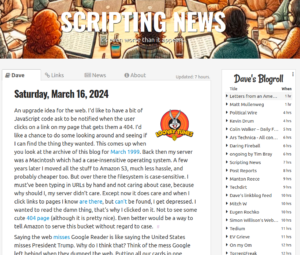
A few days ago, Dave Winer, one of the true pioneers of the Internet age, marked the beginning of his fourth decade of blogging. Just saying that is amazing.

I became a blogger because of Dave. Blogging changed — in a great way — the trajectory of my career.

Let me quote from my 2004 book, We the Media, to explain. Context: I was a columnist at the San Jose Mercury News when I got the call that changed so much. Here’s the beginning of Chapter 2, “The Read-Write Web” —

I still remember the moment I saw a big piece of the future. It was mid-1999, and Dave Winer, founder of UserLand Soft­ware, had called to say there was something I had to see.

He showed me a web page. I don’t remember what the page contained except for one button. It said, “Edit This Page”—and, for me, nothing was ever the same again.

I clicked the button. Up popped a text box containing plain text and a small amount of Hypertext Markup Language (HTML), the code that tells a browser how to display a given page. Inside the box I saw the words that had been on the page. I made a small change, clicked another button that said, “Save this page” and voila, the page was saved with the changes. The software, still in prerelease mode, turned out to be one of the earliest weblog, or blog, applications.

Winer’s company was a leader in a move that brought back to life the promise, too long unmet, that Tim Berners-Lee, inventor of the Web, had wanted from the start. Berners-Lee envisioned a read/write Web. But what had emerged in the 1990s was an essentially read-only Web on which you needed an account with an ISP (Internet service provider) to host your web site, special tools, and/or HTML expertise to create a decent site.

Writing on the Net wasn’t entirely new, of course. People had done it for years in different contexts, such as email lists, forums, and newsgroups. Wikis—sites on which anyone could edit any page—also predated weblogs, but they hadn’t gained much traction outside a small user community, in part because of the techie orientation to the software.

What Winer and the early blog pioneers had created was a breakthrough. They said the Web needed to be writeable, not just readable, and they were determined to make doing so dead simple.

Thus, the read/write Web was truly born again. We could all write, not just read, in ways never before possible. For the first time in history, at least in the developed world, anyone with a computer and Internet connection could own a press. Just about anyone could make the news.

That year included many firsts. I launched my Mercury News blog using Dave’s software. I used the same platform in a journalism course I taught that fall at the University of Hong Kong — unquestionably the debut of blogging in university coursework. And, in a visit to Beijing where I spoke at an education conference, I visibly freaked out some Chinese officials by posting a photo of them on the Web while I was speaking, noting that anyone could do that now.

During Twitter’s heyday I let my blog founder. I wish I hadn’t done that, but I let convenience and reach matter more than the open web.

Meanwhile, Dave has consistently pursued his mission over these intervening decades — creating and contributing to key technology, evangelizing open communications, and so much more. Today, he’s deeply and productively engaged in the movement to reclaim the user-controlled Internet from the centralized behemoths that have taken so much control away from us. Human communication is at stake — which means our future is at stake in all kinds of ways.

Dave’s blog is a daily testament to staying power and creativity. Kudos to the man who has done so much for so many.

Lawrence O’Donnell’s commentary last night is a reminder that our “mainstream” political journalists have learned exactly nothing from their ongoing failures over the years. It was “2016 all over again,” he said of the TV “news” channels’ live broadcast of the lie-filled “press conference” Trump hosted at his Florida resort. “To make a bad news coverage situation worse,” O’Donnell said, “none of the networks – none of them – carried Kamala Harris’ speech live after the Trump appearance. None of them.”

None of them did any fact checking during the Trump fiasco, either. There was some feeble after-the-fact checking. but as O’Donnell pointed out, how hard would it have been to use part of the screen during the lie fest to point out at least some of the lies? It would have been simple.

What accounts for this ongoing failure? Money. Trump gooses ratings and is pure clickbait. Our news organizations have stopped even pretending otherwise. Which means they’ve stopped pretending – not that they ever really did – to do journalism.

I feel an abiding contempt for Big Journalism these days, especially the TV news channels. The Murdoch family’s vile Fox “News” at least makes no pretense about its scumbaggery. The others do make a pretense of doing actual journalism, and it’s all just theater. Except this is theater that could help lead to dictatorship.

Blogroll at Dave Winer's Scripting News

Dave Winer is doing his best to revive an early blogging tradition — the blogroll.

He’s innovated (again) in doing it, with features that show how recently a site he follows has been updated; links that open up to give you a thumbnail of text; and more. Really good stuff.

Update: He’s working with WordPress in a way that will bring what he’s doing to a huge number of people. Yes!

I need to figure out how to do it here.

As I noted in an earlier recent post, returning to blogging in a more serious way is grossly overdue, and I have people like Dave to thank for the impetus.

I’ll still be posting a lot at Mastodon, where I went after the increasingly evil owner of Twitter left me with no honorable alternative but to stop supporting his business. Mastodon is part of the distributed, open-source world of media that I strongly believe we need to re-embrace before it’s too late to avoid living solely in the clutches of monopolists and control freaks.

But this is my home base. It has been a reference site, for practical purposes. Now, I’m glad to say, it’s going to be a home base in a more purposeful way.

The Bezzle, by Cory DoctorowCory Doctorow’s new mystery/thriller, The Bezzle, is genre-mashing, instructive, infuriating, and compulsively readable. It’s also one of his best books.

A prequel to last year’s Red Team Blues, The Bezzle features forensic accountant Martin Hench. This is a hero who battles evil with his brains, taking on the prison-tech complex, a beyond-sleazy financial manipulator, and the irredeemably corrupt Los Angeles County Sheriff’s Department.

I won’t reveal too much of the plot. After a relatively calm (well, watch out for bison) visit to Catalina island off the coast from Los Angeles, Hench is drawn into, first, exposing a local pyramid scheme and then much broader scam. The latter, under our current financial laws, is essential legal even though it has countless more victims. In this story, the main victims are maltreated prisoners and their families, who become nothing but cash machines for sociopathic corporate bosses. LA County Sheriff’s deputies are partners in the crimes.

Hench infuses his story with a message, not solely holding our attention with the action. His commentary on how the world works is trenchant, and will anger anyone with an ounce of social conscience. You may find yourself saying, “This can’t really be happening,” but this book lays out some of the most vile realities our our society and economy. Not least are the ways lawmakers and judges have given the ultra-wealthy and their enablers permission to steal from the rest of us — and poison the lives of the people who have the least power — and do it with impunity.

The good guys have their own ethical dilemmas along the way, and some of their decisions are discomfiting. How does someone value an individual, and a friendship, compared to countless thousands of people who have no power whatever but who desperately need an ally?

The Bezzle is one of Cory’s most notable books. I put it in a category with Little Brother, Walkaway, and Radicalized.  Each of them was brilliant in its own way, and each transcended the genre it occupied. Cory (a long-time friend) has always examined the core issues of our tech-infused society through his fiction. But those books’ messages are especially powerful, the kind we have to spread widely though our society, or fall to the resurgent fascism — a terrifying collusion of extremism, tech, financial manipulation, racism, and more — that might well be in our immediate future.

Twenty years ago today, I gave a talk about “Journalism 3.0” at the O’Reilly Emerging Tech conference, which in those days was a don’t-miss annual gathering in the tech world, or at least the part of it where I found my professional tribe.

When I suggested that mobile-phone cameras would revolutionize our view of the world (they were years away from becoming ubiquitous), Cory Doctorow zeroed in on my notion that we were creating a “former audience” that would become participants, not just consumers.

I’m at Dan Gillmor’s talk on Journalism 3.0. He’s just said something that galvanized me: “The former audience.” As in “Some day soon, there will be a major, newsworthy event in Japan and there will be 400 photos taken of it in the first minute by cam-equipped cellphones. Those 400 photos will make their way to news organizations and to individuals and we will have 400 visual perspectives of that event from the ‘former audience.’”

After the talk, he urged me to turn it all into a book. Surprisingly, this hadn’t yet occurred to me, even though I’d been assembling the evidence — as a participant, not just an observer — for some time. But Cory’s imagination has always been superior to mine!

Ultimately, “We the Media” happened. And I have Cory to thank, in a major way.

Note: This is an update of an exercise I assign to students in my Digital Media Literacy course at Arizona State University. I ask them to keep a record of how they use media in a 24-hour stretch.

5:30 a.m.: Wake up and (I absolutely should not do this) check emails on my phone to see if there’s anything urgent. There never is. So far, anyway.

6:30am: At breakfast, after we watch the first few minutes of a morning TV news program, I browse a number of journalism websites including the home pages of the New York Times, the Guardian, Wall Street Journal, Washington Post, and Japan Times. Because I care a lot about the technology scene, I look at several of the best tech sites including my favorite, ArsTechnica. The other regular media check-in each day is the private Facebook group for my small town in Northern California; that group is the closest thing to news we’ll ever have in a town that’s too small to support a news organization and is almost never noticed by the bigger media organizations in our vicinity.

7 a.m.: At the desk after breakfast, I usually have several Zoom meetings.

9 a.m.: I launch TweetDeck in a web browser to see what’s up on Twitter. The people I follow there always send me to a variety of other sites, via links they post. Twitter isn’t a great spot for original content, but it’s superb (if you follow the right people) as a place where people will point you to articles, videos, etc. that help you understand the world.

I get more serious reading done at the desk, using my personal computer, than on my phone. Among the media organizations I’ve bookmarked are the Atlantic, which has become a must-read for coronavirus information. (It was sad to see that the billionaire who owns the Atlantic felt it necessary to lay off roughly a sixth of the staff a year ago; if she can’t see this through, who can?)

9, 10, 11 a.m., 12, 1, 2, etc. p.m.: Like many others at this point, I spend several hours a day in my email, Slack channels, and other communications venues that are critical to my work. Those often lead me to other reading — research papers, news articles, and more. It never stops, and I will never reach the fabled “Inbox Zero.”

Several times a day I am in Zoom video meetings with colleagues, family, or friends. This is a major shift, and I suspect it may be longer-lasting than I’d originally imagined. Various family members gather each Sunday on video, and we’ve become closer than we were before. The vast improvements in these tools in recent years has made it possible, as has better Internet bandwidth that (so far) hasn’t failed during the pandemic.

3 p.m.: I write a fair amount each day, though not nearly as much as I did when I was a working journalist. Beyond emails, Slack, and other messaging applications that dominate work life, I spend way too much time posting on Twitter. I also write in my personal blog from time to time, and post about once a day — usually a photo — to Facebook.

I don’t listen to much music while I work. When I do it’s usually from my own collection of MP3s, ripped from my CD collection (I even have some old vinyl LP records). I prefer instrumentals that aren’t musically challenging to accompany work, because otherwise I’d actively listen to the sounds, defeating the purpose of background music.

Kermit and Miss Piggy
Disney

7 p.m.: We often watch videos in the evening — primarily films and TV programs via Netflix and Amazon Prime Video. At the moment we’re in about to start watching the Muppet Show from the 1970s. Really.

9 p.m.: My main book reading is in the evening, on a Kindle. Currently I’m immersed in several mysteries and a history from the World War II era. I read about two books a week, fiction and nonfiction. Reading gives me a lot of satisfaction, and I wish I could do more.

How do I rate news outlets?

I give the news outlets I regularly follow an A score. That includes the New York Times, Guardian, Journal (except the editorials/commentaries), and my regular tech outlets, especially ArsTechnica. In each case I trust that they have done solid journalistic work, using sound practices. That doesn’t mean they’re perfect, because they are definitely not perfect. But they do their jobs and (usually) correct their errors. That’s as much as I can hope for.

My town’s Facebook group ranges in quality from A to D, reflecting the reality that some people there post great material and others do not. However, you’ll notice I don’t rate anyone at F. That’s because we have a moderator who does a great job keeping the group civil, and focused on our town’s issues, not national politics.

The global freak-out over Facebook’s (temporary, no doubt) decision to remove Australian news sites from its users’ feeds reflects multiple misunderstandings — some of which are plainly deliberate — about what’s going on Down Under. Here’s my take, which is drawn largely from my earlier Twitter thread:

At the heart of the matter is Australia’s desire to help media companies — at least media companies with political clout — replace advertising money that moved from their inefficient operations to (apparently) more efficient ones. To force this,the government wants Facebook-Google to pay media companies, notably Rupert Murdoch’s media companies, for the privilege of sending traffic to articles on his websites.

This is a tax on linking, though it isn’t called that, and it does more than reward one of the most vile people on our planet. It breaks the open Internet.

No one should have to pay to link to someone else’s public web page. If news organizations want to stop inbound links, they can add a tiny snippet of code. They will never, ever do this.

What the media companies — led by transcendentally cynical people, Murdoch at the front — want is a replacement for the money they once collected when they held substantial control over where advertising appeared, and what it cost.

Their anti-tech propaganda campaign would have you believe that they have a righteous, god-given claim to advertising revenues. Why is that?

Because ads once supported some of the journalism that some media owners offered to some demographics in some communities. That’s their logic (a word that belongs in scare quotes).

That support came at a cost of its own: a market failure represented by the news owners’ monopoly/oligopoly that they ruthlessly exploited. Advertisers got royally screwed in the good old days. Who paid for that? Their customers, eventually.

The news organizations’ advertising dominance also screwed the general public in a direct way. If you ever placed a classified ad in the good old days you paid extortionate prices for a crappy service.

It is absolutely true that some news organizations used some of their monopoly rents to produce something of public value in some places for some of the people who lived there: journalism. That was a good thing, and we still need journalism, more than ever. And we need to do more, much more, to support journalism.

We also need to limit the power of the tech giants, in any number of arenas and in any number of ways. These are separate issues.

Political manipulations to support journalism by forcing two tech companies to give money to a few media companies are just another kind of market-rigging. Australia and other governments in thrall to Murdoch et al would be much more honest to simply tax the tech industry and have the government give the money to the media companies.

I’m not a big fan of direct taxpayer support of journalism, but if that’s what people want to do, go for it. Just be straightforward about it. But the Australian scheme is such a con, and not solely because the beneficiaries are boundless hypocrites.

For one thing, transferring money from new robber barons to old ones won’t do much, if anything, to boost the kind of local journalism we need everywhere, in all communities. And it ignores the much more serious platform issues.

One of those issues is whether online advertising is, as I believe the evidence is increasingly making clear, a giant con game that rips off everyone but the evil ad-tech industry. (See also Cory Doctorow’s red-hot post on this situation.) If this is the case, the advertisers are obviously victims and should be in court yesterday to recoup losses. But if there’s a direct link to news organizations’ decline, that suggests another course of action: To the extent that revenues that had once gone to news orgs, and that provably moved to platforms, were moved there because of fraud — isn’t that a slam-dunk antitrust and/or fraud civil lawsuit? Yale Law School’s Dina Srinivasan says yes, absolutely (h/t Cory for that link).

If Australia’s move becomes the norm, it will entrench the tech platforms even more. If they become the financial lifelines for (some) media businesses, those enterprises will become the platforms’ most ardent defenders. Tech journalism is inept enough already, but this will make it worse.

I’m disappointed that Google has given into the pressure and cut a deal with the Murdoch family. The company has made such deals elsewhere (France in particular), and the company policy now seems to be to fold when Big Media have enough clout with local governments.

Facebook (disclosure: it has funded some of our work) acted with surprising clumsiness in Australia. Yet its stance is closer to the right one than Google’s.

Taxing links breaks the Internet. Don’t do it.

Supporting journalism is essential. Do it, but do it the right way.