Over at Press Watch, Dan Froomkin has posted a scathing piece about the willfully clueless New York Times Washington Bureau (and its bosses in New York). He calls it “The Washington press corps doesn’t have a freaking clue,” and he’s right on point.

It is just infuriating at this point — or “sickening,” as Dan puts it — to watch DC political journalists live down to expectations, at a time when they needed to live up to professional duties.

But they won’t. We should just face it — and move on.

I’m working on an idea that I hope will turn into something useful this year and — assuming the Trump cult doesn’t flip the switch and turn the U.S. into a dictatorship —  beyond. I’ll have more to say about it soon, but it involves the endless corruption in Trump world, which journalists treat in general like a standing joke, not the horror show it actually is.

Meanwhile, read Dan’s piece. It’s outstanding.

I made the mistake, many years ago, of publishing an April Fools Day joke column in the San Jose Mercury News. The piece, co-written with Michael Schrage, a friend, reported that Stanford University had decided to take itself public — that is, become a publicly traded for-profit company — because so many billions of dollars were available for harvest from suckers during the tech boom of the late 1990s.

The column, only available today from behind a paywall, started:

Just when you think Silicon Valley’s e-mania couldn’t get any more extreme, it does. Get ready for the Stanford University dot-com IPO.

Yes, Stanford — the academic institution most responsible for seeding the valley’s high-bandwidth culture of innovation and entrepreneurship — wants in on the action in a more direct way.

And you know what? It makes more sense than a lot of the deals we’ve seen.

Sources say the university is planning to bundle together some of its key assets and sell shares in an initial public offering sometime this summer. And the valuation looks like it’ll be north of $100 billion.

The insiders in this deal are fighting among themselves about everything — from the underwriter to the name of the spinoff. Stanford.com has been rejected as ”too close to the offline brand,” according to a deal memo we’ve seen. Some of the possible names include eStanford.com and iStanford.com (the ”i” would stand for ”Internet”).

Naturally, Wall Street institutions are already warring over this deal. Every big investment bank wants the lead position in the IPO. So it’s more than a little surprising to hear that Weeke & Chernem Securities — the bank that took the ill-fated, sleazy eTattler.com public a year ago — seems to have the inside track.

I arrived at the office that morning and found several voicemail (remember voicemail) messages. One of them was an inquiry about how to invest. Another was from a tech executive who said, “You really me going there — until I realized it was a joke.”

However clever Michael and I might have been with that piece, it was a bad idea. I came to realize that satire on the Internet should be left solely to the experts. Only one site is consistently superb in this category, the Onion. The rest of us are nowhere by comparison, and our chief accomplishment is to confuse people.

That’s why the endless torrent of April Fools jokes on the Internet is an endless error in judgment. Anyone who’s planning an April 1 gag, I beg you, please don’t.

The best advice on April 1 remains something that I found more than 15 years ago at Twitter, from someone named Prentiss Riddle. He wrote: “What I like about April Fool’s Day: one day a year we’re asking whether news stories are true. It should be all 365.”

I was looking around to see if anyone is making a decent small (7″-8″) tablet running Linux, when I realized that no one is even making a good small tablet running Android. (Amazon and Samsung small tablets are not good enough, IMO.)

I have an 8-inch, second-hand iPad Mini, which I use solely for watching movies on airplanes and reading digital magazines I download from my public library. My 6.5-inch-screen phone just isn’t big enough for the latter, though it’s fine for reading books in an app.

This reminded me: Google once sold a great small Android tablet, the Nexus 7. I used it for years, until it finally died. Like so many things Google has produced — hardware and software — the company killed it off in a fit of boredom or stupidity.

The market’s still wide open for an ipad-mini competitor — and it baffles me that no one appears to be even trying to fill the gap.

You would imagine that America’s political journalists would have learned by now that democracy faces an existential threat, which means that freedom of the press — among many other freedoms — is on the block along with our system of government.

You would be wrong.

There are some honorable exceptions in major news organizations, but the reality is that coverage simply does not reflect the threat in a way that these times demand. For whatever reasons — inertia, timidity, business models, and outright cowardice, among others — Big Journalism refuses to do much more than notice the threat, and even that is a glance, not a deep look.

One way you know that it’s business as usual for journalists is that so many have remained on Twitter, a platform whose owner has taken right-wing trollery to extremes lately. He loudly supports people who want to install a fascist government in the United States, and it’s clear enough that he would support fascism if and when it arrives. Yet only a smattering of journalists left, and far too many have stuck around actively posting. They would deny this, but the inescapable truth is that active use of Twitter is active support of its owner’s business.

If fascism arrives, a lot of these journalists will be fine. After all, they’re helping to create the conditions for a new Trump presidency. But a lot more will not be fine — and even the ones that are in favor under a Trump government will eventually realize that their safety and livelihoods are at the whim of the extreme right-wing cultists who’ll be in control.

There’s so little time left for journalists to wake up, and it’s clear to me that they won’t. They may be good and kind and talented people in other ways, but in this they mocking their duty. They will be remembered, if historians of the future are honest and have access to the facts, as complicit — if not outright collaborators — in the American experiment’s demise.

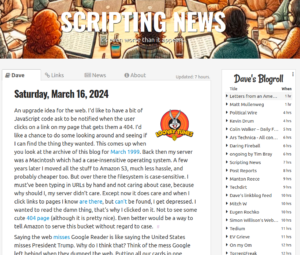
Blogroll at Dave Winer's Scripting News

Dave Winer is doing his best to revive an early blogging tradition — the blogroll.

He’s innovated (again) in doing it, with features that show how recently a site he follows has been updated; links that open up to give you a thumbnail of text; and more. Really good stuff.

Update: He’s working with WordPress in a way that will bring what he’s doing to a huge number of people. Yes!

I need to figure out how to do it here.

As I noted in an earlier recent post, returning to blogging in a more serious way is grossly overdue, and I have people like Dave to thank for the impetus.

I’ll still be posting a lot at Mastodon, where I went after the increasingly evil owner of Twitter left me with no honorable alternative but to stop supporting his business. Mastodon is part of the distributed, open-source world of media that I strongly believe we need to re-embrace before it’s too late to avoid living solely in the clutches of monopolists and control freaks.

But this is my home base. It has been a reference site, for practical purposes. Now, I’m glad to say, it’s going to be a home base in a more purposeful way.

SF Chronicle: California’s high-speed rail needs $100 billion to finish — scrapping the project is a possibility

I’m a huge fan of high-speed trains, but California’s project gets more and more unfathomable as the costs escalate with no pretense of honest accounting.

They should either shut it down, right now, or prove they can finish without further ridiculous overruns. It all smells like a giant scam.

Investigating this should be on journalism’s agenda. (I’d love to see ProPublica take a crack at it. Instead, what we see from news media are mostly incremental “discoveries” that the costs have — yet again — soared from the previously avowed estimates.

I hate saying this, and I’ve already gotten some pushback at Mastodon. Waldo Jaquith, who knows his way around governmental projects, wrote:

Major transit projects, like major tech projects, routinely cost multiples of their planned costs, for the same reasons. The solutions: have the state actually employ engineers etc. to oversee the work knowledgably, inspect the actual work being done *constantly*, cancel contracts for non-performing vendors, and don’t have a single prime vendor that outsources to a bajillion subs.

This isn’t hard. The problem and solutions are well documented.

Maybe so. But the solutions, however well documented, don’t ever seem to be put into practice — and California is notorious for expensive, failed projects.

This project is — quite visibly — little but smoke and mirrors. The state keeps launching endless billions of our dollars into…what?

California high-speed rail should have happened. Long ago. But the people who’ve profited from it have vaporized too much of our money at this point. They are obviously not going to become honest, or competent, enough to actually finish this project. I loathe them and their enablers, because they’ve compromised California’s future.

But it looks to me like it’s over, kaput. The only question seems to be when we’ll stop throwing good money after bad.

I’m quite active at Mastodon these days. But it’s time to come back to blogging, too.

I was early and super-active in the blogging world. But like so many others, I let it slide for many years after social media (especially Twitter) came along. I devoted too much of my time and creative juices to centralized platforms controlled by rapacious entrepreneurs and, more recently, outright sociopaths.

I’m glad to be back…

The Bezzle, by Cory DoctorowCory Doctorow’s new mystery/thriller, The Bezzle, is genre-mashing, instructive, infuriating, and compulsively readable. It’s also one of his best books.

A prequel to last year’s Red Team Blues, The Bezzle features forensic accountant Martin Hench. This is a hero who battles evil with his brains, taking on the prison-tech complex, a beyond-sleazy financial manipulator, and the irredeemably corrupt Los Angeles County Sheriff’s Department.

I won’t reveal too much of the plot. After a relatively calm (well, watch out for bison) visit to Catalina island off the coast from Los Angeles, Hench is drawn into, first, exposing a local pyramid scheme and then much broader scam. The latter, under our current financial laws, is essential legal even though it has countless more victims. In this story, the main victims are maltreated prisoners and their families, who become nothing but cash machines for sociopathic corporate bosses. LA County Sheriff’s deputies are partners in the crimes.

Hench infuses his story with a message, not solely holding our attention with the action. His commentary on how the world works is trenchant, and will anger anyone with an ounce of social conscience. You may find yourself saying, “This can’t really be happening,” but this book lays out some of the most vile realities our our society and economy. Not least are the ways lawmakers and judges have given the ultra-wealthy and their enablers permission to steal from the rest of us — and poison the lives of the people who have the least power — and do it with impunity.

The good guys have their own ethical dilemmas along the way, and some of their decisions are discomfiting. How does someone value an individual, and a friendship, compared to countless thousands of people who have no power whatever but who desperately need an ally?

The Bezzle is one of Cory’s most notable books. I put it in a category with Little Brother, Walkaway, and Radicalized.  Each of them was brilliant in its own way, and each transcended the genre it occupied. Cory (a long-time friend) has always examined the core issues of our tech-infused society through his fiction. But those books’ messages are especially powerful, the kind we have to spread widely though our society, or fall to the resurgent fascism — a terrifying collusion of extremism, tech, financial manipulation, racism, and more — that might well be in our immediate future.