(This is adapted from my 2009 book Mediactive.)

My friend and Arizona State University colleague Tim McGuire said many years ago, “The fact is one stupid mistake when you are 19 today can kill your future.”

That’s true—today, anyway, as we learn that what we do online can often be rediscovered years later. Such is the case of Alexi McCammond, who was named editor of Teen Vogue and then dethroned after anti-Asian tweets from a decade ago were uncovered.

It’s been the common wisdom for years. Back in 2009, then-President Obama told 9th graders at a Virginia school:

“I want everybody here to be careful about what you post on Facebook — because in the YouTube age, whatever you do, it will be pulled up again later somewhere in your life. And when you’re young, you make mistakes and you do some stupid stuff.  And I’ve been hearing a lot about young people who — you know, they’re posting stuff on Facebook, and then suddenly they go apply for a job and somebody has done a search and — so that’s some practical political advice for you right there.”

Young people make mistakes and do stupid things. So do older people, of course. Luckily for me and most of my friends, my generation’s youthful stupidities are mostly lost in the mists of time, not preserved on somewhere in the digital cloud.

But the notion of punishing someone decades later for what he or she said or did as a teenager or college student isn’t just wrong. It’s dangerous.

What matters is who you are today. If some said racist things as a teenager and is still demonstrating today that he or she harbors racist beliefs or acts in racist ways, I want no part of that person.

We’re going to have to cut each other some slack. There’s no alternative.

A journalism student of mine once asked if it was advisable to have a personal blog and, if so, to be outspoken on it. He’d apparently been warned that it could put a crimp in his future journalism career plans.

I can’t say how others would react. I do know that if I were hiring someone today I’d want to know what (not if) he or she posted online, not to find disqualifying factors but to see if that person had interesting things to say. I’d take for granted that I might find some things that were risqué or inappropriate for my current world. I’d expect to find things that would be “unjournalistic” in some ways, such as outspoken or foolish (or both) views on important people and issues. But I’d also remember my own ability, if not tendency, to be an idiot when I was that age. And I’d discount appropriately.

This is all about giving people what my friend Esther Dyson, a technology investor and seer, has called a “statute of limitations on stupidity.” If our norms don’t bend so that we can all start cutting each other more slack in this increasingly transparent society, we’ll only promote drones—the least imaginative, dullest people—into positions of authority. Now that’s really scary.

I hope we’ll make more progress on this than we’re showing at the moment. In some ways we are. Recall that it was impossible for a Catholic to be president until John F. Kennedy was elected. It was impossible for a divorced person to be elected until Ronald Reagan won. It was impossible for a former pot smoker to be president until Bill Clinton got elected. (Biden is stupidly undoing this with his firing of staffers who admit they ever used weed.) George W. Bush acknowledged having been a dissolute drunk until he was 40. And so on.

Sometime in the foreseeable future, we’ll elect a president who tweeted regularly, or had a blog or a Facebook or Instagram page when she was a teenager. By the standards of today, such a person would be utterly disqualified for any serious political job. But if we adapt as I believe we’ll have to, we’ll have grown as a society; we’ll have become not just more tolerant of flaws, but more understanding that we all have feet of clay in some respect. We’ll elect her anyway, because we’ll realize that the person she has become—and how that happened—is what counts.

How will her peers know all this? They’ll have figured it out for themselves, but they’ll have had some help, too. They’ll have been taught, from an early age.

The global freak-out over Facebook’s (temporary, no doubt) decision to remove Australian news sites from its users’ feeds reflects multiple misunderstandings — some of which are plainly deliberate — about what’s going on Down Under. Here’s my take, which is drawn largely from my earlier Twitter thread:

At the heart of the matter is Australia’s desire to help media companies — at least media companies with political clout — replace advertising money that moved from their inefficient operations to (apparently) more efficient ones. To force this,the government wants Facebook-Google to pay media companies, notably Rupert Murdoch’s media companies, for the privilege of sending traffic to articles on his websites.

This is a tax on linking, though it isn’t called that, and it does more than reward one of the most vile people on our planet. It breaks the open Internet.

No one should have to pay to link to someone else’s public web page. If news organizations want to stop inbound links, they can add a tiny snippet of code. They will never, ever do this.

What the media companies — led by transcendentally cynical people, Murdoch at the front — want is a replacement for the money they once collected when they held substantial control over where advertising appeared, and what it cost.

Their anti-tech propaganda campaign would have you believe that they have a righteous, god-given claim to advertising revenues. Why is that?

Because ads once supported some of the journalism that some media owners offered to some demographics in some communities. That’s their logic (a word that belongs in scare quotes).

That support came at a cost of its own: a market failure represented by the news owners’ monopoly/oligopoly that they ruthlessly exploited. Advertisers got royally screwed in the good old days. Who paid for that? Their customers, eventually.

The news organizations’ advertising dominance also screwed the general public in a direct way. If you ever placed a classified ad in the good old days you paid extortionate prices for a crappy service.

It is absolutely true that some news organizations used some of their monopoly rents to produce something of public value in some places for some of the people who lived there: journalism. That was a good thing, and we still need journalism, more than ever. And we need to do more, much more, to support journalism.

We also need to limit the power of the tech giants, in any number of arenas and in any number of ways. These are separate issues.

Political manipulations to support journalism by forcing two tech companies to give money to a few media companies are just another kind of market-rigging. Australia and other governments in thrall to Murdoch et al would be much more honest to simply tax the tech industry and have the government give the money to the media companies.

I’m not a big fan of direct taxpayer support of journalism, but if that’s what people want to do, go for it. Just be straightforward about it. But the Australian scheme is such a con, and not solely because the beneficiaries are boundless hypocrites.

For one thing, transferring money from new robber barons to old ones won’t do much, if anything, to boost the kind of local journalism we need everywhere, in all communities. And it ignores the much more serious platform issues.

One of those issues is whether online advertising is, as I believe the evidence is increasingly making clear, a giant con game that rips off everyone but the evil ad-tech industry. (See also Cory Doctorow’s red-hot post on this situation.) If this is the case, the advertisers are obviously victims and should be in court yesterday to recoup losses. But if there’s a direct link to news organizations’ decline, that suggests another course of action: To the extent that revenues that had once gone to news orgs, and that provably moved to platforms, were moved there because of fraud — isn’t that a slam-dunk antitrust and/or fraud civil lawsuit? Yale Law School’s Dina Srinivasan says yes, absolutely (h/t Cory for that link).

If Australia’s move becomes the norm, it will entrench the tech platforms even more. If they become the financial lifelines for (some) media businesses, those enterprises will become the platforms’ most ardent defenders. Tech journalism is inept enough already, but this will make it worse.

I’m disappointed that Google has given into the pressure and cut a deal with the Murdoch family. The company has made such deals elsewhere (France in particular), and the company policy now seems to be to fold when Big Media have enough clout with local governments.

Facebook (disclosure: it has funded some of our work) acted with surprising clumsiness in Australia. Yet its stance is closer to the right one than Google’s.

Taxing links breaks the Internet. Don’t do it.

Supporting journalism is essential. Do it, but do it the right way.

Fifteen years ago this week, I had 15 minutes of fame in Japan when my book We the Media was published in translation and the nation’s largest news magazine, Aera, put me on the cover. It was weird, but also gratifying in lots of ways.

Kaz Taira translated the book (and did the same with a follow-on book, “Mediactive” a few years later), and Katsura Hattori wrote an afterword. It was an honor to work with them, and we’ve become friends since. I look forward to the day when we can meet again in Tokyo for dinner, as we’ve done on several occasions in recent years.

乾杯!

At the top of the Washington Post’s website, a day after the second Trump-Biden presidential campaign debate, is a story entitled, “Trump seeks momentum from debate while Biden focuses on pandemic.” Read it and you’ll see a classic example of political coverage: an insider compendium that seeks to frame the debate’s impact on the race.

Washington Post home page

This story has a hollow core: empty space surrounded by the oh-so-savvy insider-isms that political journalists can’t resist. (Yes, it’s also a horse-race story, but at this point in the political cycle, that’s probably appropriate.)

The hole in this story is ignoring the central feature of the debate, which is not that the president’s overt behavior was slightly less obnoxious than during the first face-off with Biden. No, the central reality was that Trump lied incessantly and brazenly, spewing deceit about every topic that came up during the 90-minute TV event.

You won’t find the word “lie” in the piece, of course. Big Journalism does carnival-quality contortions to avoid using that clear and — in Trump’s case — plainly accurate word. Big Journalism only resorts to it when something the president’s standard-issue deceit rises to a level of brazenness that even timid news organization’s can’t justify a tamer word.

But “lie” isn’t the only missing word. So are “false” and “deceive” and “untrue” and, as far as I can tell, any other word that might even hint at the fountain of deceit that erupted — as usual — from the president of the United States.

That may account for the missing context in the Post’s story. Journalists have thoroughly normalized Trump’s lying. So perhaps it didn’t occur to the team of reporters to mention that central reality of the debate — nor, maybe worse, to their editors who put the story at the top of their home page.

Perhaps they assumed all readers already understood the context. I do note, meanwhile, that the Post featured a story — right next to this one on the home page — on one of Trump’s repeatedly told lies.

But very few people will see the Post story in that context, because most people arrive at story pages via social media and other links. And when they read this horse-race special, they won’t be reminded of the core reality of Donald Trump: his relentless, malign deceit during the event the story was covering. Journalism should be better than this.

WordPress has just added a feature to its blogging software that, in theory, looks like a winner. It’s supposed to break up blog posts that are longer than the 280 characters allowed in individual tweets (almost there…) into threads. And, according to the company that makes this software, it will do so in an elegant fashion. So let’s see.

The first issue, and nearly a showstopper, is that I’m required to use the “blocks” editing system that WordPress has been pushing on its users for a while now. I’m totally accustomed to the old system’s simple editor, which lets me focus on the words and, when I need to, drop an image into the post. But I’m an old, unreconstructed blogger from ancient times, as we like to refer to the years from 1999 to roughly 2010, when social media became, more and more, the primary outlet for a lot of us.

I started this post with a screen shot from Twitter (actually TweetDeck), reduced slightly and embedded into the post. I’m not sure how it’s going to look yet in Twitter, but it looks OK in WP for the moment.

I’m going to click the JetPack link in the upper right to see how the Twitter integration works. (It was already working well for posting single tweets.) I see that it gives me some useful options, not least a) a way to customize the introduction message; and b) decide whether to post the entire thread on Twitter or simply link to this post there. (I’d like the option to forego the introductory tweet and just post the thread directly.)

When I preview the thread I see that WordPress often, but not always, breaks up the post into single sentences from the blog post. That’s not optimal, but I can understand the logic.

It also lets me edit where those breaks will not occur — I don’t see a way to force a break. That’s not ideal. I tried it and some of the breaks further down got wonky.

I’d also like to have WP automatically put in indicators of where I am in the thread, e.g. 1/x, 2/x, 3/x…10/end to give a reader a better indication of where the particular tweet comes in the sequence, and to be another alert that it’s part of a thread or, if I get ambitious, a tweetstorm.

Whoops, I see in the last one that it broke in the middle of the sentence, adding ellipses at the end of one tweet and the beginning of the next one. So much for my theory that it does complete sentences.

This seems to work pretty well, overall. I’m planning to give it more of a workout soon.

I’m honored that Keio University’s Cyber Civilization Research Center has named me a (non-resident) Senior Fellow. The center, based in Tokyo, is the brainchild of two real (in contrast to me) luminaries: Jun Murai, widely known as the person who did most to create the Japanese Internet, and David Farber, an American who has been at the top ranks of computer networking and education for decades. Keio is generally regarded as the top private university in Japan.

Dave and I have been running a weekly online gathering, in which a special guest discusses some aspect of our rapidly changing world. Our attendees are scholars, scientists, engineers, people from business and NGOs, and more. I learn something new every time.

My work with the News Co/Lab and the Cronkite School at ASU continues. (Our new free online media literacy course launches a big session this weekend.)

Note: This is an exercise I assign to students in my Digital Media Literacy course at Arizona State University. I ask them to keep a record of how they use media in a 24-hour stretch.

5:30 a.m.: Wake up and (I should not do this) check emails on my phone to see if there’s anything urgent. There never is. So far, anyway. 
6:30am: At breakfast, after we watch the first few minutes of a morning TV news program, I browse a number of journalism websites including the home pages of the New York Times, Guardian, Wall Street Journal, Washington Post, and Japan Times. Because I care a lot about the technology scene, I look at several of the best tech sites including ArsTechnica and ReCode. The other regular media check-in each day is the private Facebook group for my small town in Northern California; that group is the closest thing to news we’ll ever have in a town that’s too small to support a news organization and is almost never noticed by the bigger media organizations in our vicinity. 


7 a.m.: At the desk after breakfast, I usually have several Zoom meetings.
9 a.m.: I launch TweetDeck in a web browser to see what’s up on Twitter. The people I follow there always send me to a variety of other sites, via links they post. Twitter isn’t a great spot for original content, but it’s superb (if you follow the right people) as a place where people will point you to articles, videos, etc. that help you understand the world. 
 
I get more serious reading done at the desk, using my personal computer, than on my phone. Among the media organizations I’ve bookmarked are the Atlantic, which has become a must-read for coronavirus information. (It was sad to see that the billionaires who own the Atlantic felt it necessary to lay off roughly a sixth of the staff in May; if they can’t see this through, who can?) 
9, 10, 11 a.m., 12, 1, 2, etc. p.m.: Like many others at this point, I spend several hours a day in my email, Slack channels, and other communications venues that are critical to my work. Those often lead me to other reading — research papers, news articles, and more. It never stops, and I will never reach the fabled “Inbox Zero.” 
Several times a day I am in Zoom video meetings with colleagues, family, or friends. This is a major shift, and I suspect it may be longer-lasting than I’d originally imagined. Various family members gather each Sunday on video, and we’ve become closer than we were before. The vast improvements in these tools in recent years has made it possible, as has better Internet bandwidth that (so far) hasn’t failed during the pandemic. 
3 p.m.: I write a fair amount each day, though not nearly as much as I did when I was a working journalist. Beyond emails, Slack, and other messaging applications that dominate work life, I spend way too much time posting on Twitter. I also write in my personal blog from time to time, and post about once a day — usually a photo — to Facebook.  
I don’t listen to much music while I work. When I do it’s usually from my own collection of MP3s, ripped from my CD collection. I prefer instrumentals that aren’t musically challenging to accompany work, because otherwise I’d actively listen to the sounds, defeating the purpose of background music. 
7 p.m.: We often watch videos in the evening — primarily films and TV programs via Netflix and Amazon Prime Video. At the moment we’re in Season One of Downton Abbey, which I’d seen but holds up nicely on second viewing years later. 
 
9 p.m.: My main book reading is in the evening, on a Kindle. Currently I’m immersed in a near-future science-fiction novel (by someone I know) that will be released in a few weeks. I read about two books a week, fiction and nonfiction. Reading gives me a lot of satisfaction, and I wish I could do more. 

How do I rate news outlets?

So an AT&T subsidiary that owns HBO is laying off “hundreds” of people there, and will focus on the new HBO Max streaming service. I want to send them money to use that service. But due to a gratuitously stupid decision someone made there recently, I just canceled my one-month-old HBO Max account.

They could not care less.

I use Ubuntu Linux on my laptop computer. I can use every other major streaming service with no problem, running in a Firefox browser.

I got a trial account for HBO Max a month ago, and all was well until three days ago, when films and shows just stopped streaming. The error message said “Can’t play title. We’re having trouble playing this video. Please try again later.” A quick check of online message boards showed that this is a universal new policy affecting most or all Linux distributions.

This happened on all browsers I tried. But streaming did work when I used an app on my phone, which has a screen far too small for watching movies in any serious way.

Here’s what “customer support” told me in an email: “We do not support usage under this operating system.”

Remember, however, they did support it. It worked fine until someone made a decision to make it fail.

This is all some kind of corporate copyright control-freakery at work, no doubt. DRM is involved, and HBO/AT&T have made a choice. I’ve made mine.

Looks like I’ll never watch “Game of Thrones” after all…

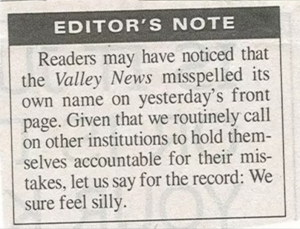
Funny correction(UPDATE: This post originally contained an error. The Fort Worth Star-Telegram, not The Kansas City Star, published the errant column I referred to below. If you spotted it and let me know, congratulations — and thanks for helping us with this project.)

The ASU News Co/Lab is deploying a “corrections tool” — a way to help journalistic corrections and major updates travel the same social media pathways as the original errors — into several newsrooms soon. This post is part of that process, as I’ll explain here.

The News Co/Lab’s Corrections Project is based on several notions: First, we believe that forthright corrections are a fundamental, essential part of journalistic transparency. Second, we can help automate the process of sending them down those social media pathways — to alert people who’d shared the original articles that there was a correction or significant update. Finally, we hope to help the news industry (and others who believe in the best journalistic principles) come up with a standard for creating and publishing corrections.

Our software developer, Ted Han, has been building the web-based corrections tool. It has two main parts:

  • Discovery — finding who shared the original.
  • Response — alerting sharers to the update, with the goal of getting them to share the update.

We’re using data generated by social media and analytics companies, bringing it into the tool to show journalists the reach of what they’ve published, and then decide which sharers of that content should get alerts when a correction is published.

How is this possible? Last year, we devised a methodology with our partners at McClatchy, a major news company. We described our approach in a blog post— our example was a column in the Fort Worth Star-Telegram, in which the columnist quoted from a news article that was based on incorrect information a government agency had provided — and how we planned to use technology to automate the hands-on process of sending out updates we used in that case.

As I said in the headline above, this post has a mistake in it. We’re asking a few of our friends to tweet about the post or retweet our own tweets. Once we’ve been informed — maybe by you? — of the mistake, I’ll correct this post here. Then I’ll use the tool to find out who shared it, and will further use it to alert several of those people who tweeted about the original.

This is a test to see how it all works, and to generate screen shots for a Users Guide we’ll give newsrooms as they test the tool.

So, if you can find the error, let me know (and include your Twitter handle so I can credit you there).

(Note: This is adapted from a “Tweetstorm” earlier today.)

More than a decade ago I begged journalists and sharers of breaking news to employ a “slow news” approach. The Kobe Bryant story demonstrates that need more than ever.

What’s slow news? It’s the notion that we should slow down before publishing information we can’t absolutely verify, and before believing what we’ve seen published.

I’m sorry to say that we haven’t made enough progress. Slowing down before publishing is the duty (I believe it should be viewed that way) of journalists and social media sharers. Yesterday’s barrage of misinformation, incomplete information, and guesses demonstrated that we’re not close.

Since we can’t expect journalists to do it, and social media’s vastness guarantees that incomplete or wrong information will spread fast, it’s really up to the rest of us — the “consumers” of information — to adopt a slow-news philosophy.

In our digital media literacy course at the Cronkite School, Kristy Roschke and I ask students to pause before believing or sharing pretty much anything, especially when it’s breaking news or a fast-developing story. We use examples like this to show why that’s needed.It comes down to this:

The faster the news accelerates, the slower I am inclined to believe anything I hear — and the harder I look for the coverage that pulls together the most facts with the most clarity about what’s known and what’s speculation.

Meanwhile, if journalists won’t stop spraying out the latest speculation, the least they can do is to find ways to get updates and corrections to as many of the people who’ve read the early “news” as quickly and broadly as possible.

At the ASU News Co/Lab, which I co-founded a couple of years ago, we’re working on ways to help journalists and prominent sharers do just that. A tool, now under development, can partially automate the process of sending corrections down the same social pathways that the original errors traveled.

We’re in “pre-alpha” testing of the tool, which Ted Han is developing, and it looks promising. More on this work here.

(If you’re in a newsroom and want to get a look at this, let us know!

While the tool is aimed first at corrections of major errors, we see updates in these kinds of situations as an important use case. Sometimes the original information isn’t “wrong” in a traditional journalistic sense — example: the police give out an incorrect death toll.

But the public doesn’t care where the misinformation came from, and a journalistic duty is to get the correct information out there, pronto. So when the news is “developing” — if you see that word on a story, it’s probably changing fast — we may be able to help.

I’m under no illusions that slow news will become the norm for creators of information, certainly not for newsrooms or people who use social media as an attention-getter. But I hope we can make progress and reduce at least some of the rumor-mongering.

As creators and consumers, we all need to reflect on what we’re doing. Please consider adopting a slow news approach.

It boils down to this: Take a breath, and think.