The most obvious takeaway from the “Attaboy Joe” editorials and commentaries is not that they’re offering sincere thanks for a fine president’s selfless act.
No, they’re congratulating themselves, having played a central role in hounding him off the ticket. They’re feeling powerful now.
Keep that in mind, because they like the idea that they can exert power from their safe perches, outside the arena where they take no risks, and are never held accountable for their epic failures. But they only even attempt to do this kind of thing with Democrats. Republicans hold journalism in pure contempt. A lot journalists — perhaps rationally — act as though they are physically afraid of the consequence of telling truth to right-wing power. They know Democrats are too civilized to do more than complain.
God, I want journalism that respects the people it claims to serve.
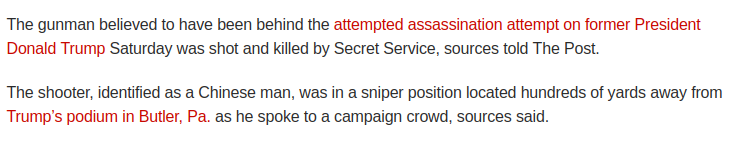
The Murdoch family’s rancid New York Post, in its early coverage of the Trump rally shooting, claimed the shooter was Chinese, citing unnamed “sources”. As we know, the shooter was a white man from Pennsylvania.
The story was fixed — but without, as far as I can see, any correction much less the apology that should have accompanied the revised piece.
It’s useful to keep in mind that the Murdoch empire routinely injects poison into our civic bloodstream, for power and money. It is an evil company, and no journalist with a sense of honor should work for them.
I’m working on a project to highlight solid journalism about the 2024 election — in particular, work that:
1) clearly explains what is at stake, overall and more specifically by topic (e.g. economy, rule of law, environment, civil rights/liberties, voting rights, etc.)
2) offers examples on what people on the ground are doing, successfully, to protect democracy, etc.
Let me know in the comments below or, even better, by email:
If you were waiting for proof that Joe Kahn, the top editor at the New York Times, doesn’t even begin to appreciate the danger of a Trump 2 presidency, this is it, from an interview in the New Yorker:
Q: If Trump wins a second term, can you outline how the Times plans to cover that? How are you thinking about this potential norm-breaking period?
A: Fasten your seatbelts. If Trump wins again, the New York Times will be committed to covering every aspect of that story as it unfolds. It would be, as our reporting shows, a disruptive Presidency if he wins. We will have a full-time job covering the implications of that. And we’ll need a team of people who are geared up, as in the first term, but even more so, for a very disruptive presence in the White House. And what we’ll do is we’ll show up and we’ll do our jobs.
If Trump’s avowed dictatorship comes to pass, you will be able to count on the Times covering it, ever so politely — at least until the brownshirts come for the journalists they don’t like.
(BTW it’s also plain that the interviewer doesn’t want to face the implications, either.)
In its no-holds-barred campaign to get Biden off the Democratic ticket in this year’s presidential election, the New York Times has reached a level of journalistic activism I haven’t seen from that organization in my lifetime. Although the Times won’t acknowledge that it’s doing this, or explain why or who’s making the decisions, the onslaught from both the editorial and “news” pages leaves no doubt in my mind, and I’m not remotely alone on that.
But when the Times published what will someday be the focus of ethics classes in journalism schools — an account of neurologist visits to the White House, inviting unfounded speculation that Biden has Parkinson’s disease (he doesn’t) — we shouldn’t chalk it up to just another missile in the Times’ anti-Biden barrage.
This story was a disgrace. Dripping with innuendo, it contradicted itself once the reporters got to the place where they added context that belonged at the very top. The editors who let this story out into the world are either incompetent or indifferent to the standards that should rule in situations like this.
I’m going with indifferent, because the editors also had to know that the piece was going to launch an innuendo storm throughout the media. The Times, for better or worse, has massive influence on what other journalism organizations publish. So this story was predictably going to dominate the day in political coverage, and was the spark for a grotesque scene in the White House press room, where journalists shouted at a press secretary who was a hundred times more competent and respectful than they were.
The Times killed off the position of public editor in 2017, early in the Trump administration. If that post was reinstated and occupied today by someone who had authority and honor, I have zero doubt that he or she would be preparing a scathing denunciation of this pathetic episode.
***
Someone who follows my work suggested to me that the Times must know something devastating about Biden that it can’t print (yet), for whatever reason. I’ll grant the possibility, but would rate the probability as roughly the same as winning big money in a lottery. The likeliest explanation for anything, per Occam’s Razor, is usually the correct one — and what’s likely here is that the Times got so caught up in its dumping on Biden that it couldn’t resist something that — only at first glance and not an inch past that — might be sensational. I don’t know and the Times almost never explains itself.
***
Note: I’ve revised my description of the Times editors who let this travesty happen. The word I originally used could be interpreted as an accusation of corruption, which I emphatically do not believe should apply here.
The screenshot above is today’s installment in the New York Times’ all-hands-on-deck campaign to get Biden to withdraw.
I want to emphasize — again — that I do not object to news organizations’ taking a stand on a matter they consider important and then pushing their view relentlessly as advocates — in news articles and commentary alike. Advocacy journalism is vital, if it’s done ethically. This isn’t even close.
Advocacy journalism, done with integrity, requires transparency. The Times keeps pretending that it’s still an impartial conveyor of what people need to know. It is not on this matter, not even close, and it refuses to be transparent — not just about doing it, but crucially who’s giving the orders and what the motivations are. Shades of the 2016 Clinton emails saga, when the Times went on a wildly dishonest binge.
Advocacy journalism also requires context. In this case, the context is stark and scary: Trump is visibly deranged, and it’s accelerating. So are his stated plans — with the backing of one of the two major political parties (including its wholly owned Supreme Court) and an army of cultists — to create a fascist America.
The Times has been, for a long time, the nation’s most important news outlet. Other journalism organizations take the Times’ lead in what national news, notably politics, that they cover and publish. The Times has disproportionate clout, and has frequently abused it.
I beg the Times to redirect its advocacy, and soon — by relentlessly making clear to its own audience, and more broadly via its influence in journalism’s broader community — the emergency it has, so far, only discussed as just one more interesting topic among many. We are on the verge of the end of the American experiment. Obsess on that, please, before it’s too late.
This is the first in a series of posts (cross-posted at Medium).
Dear journalists: This is your moment.
It’s your opportunity, maybe your final one, to stand proudly for reality and democracy, for freedom of expression, for human rights. To stand up as journalism’s best — think Ida B. Wells and Edward R. Murrow, among so many others — did in earlier times as they challenged a tide of political evil and helped America change its course. To reject the journalistic formulas that have made you not just ineffective, but downright helpless.
This is your chance to help America back from the brink, back to a path toward a more perfect union.
I write this during the week of July 4, when America celebrates our most significant holiday. This year, Independence Day arrives three days after a staggeringly dangerous ruling by our corrupted Supreme Court, clearing the way for presidents to be dictators.
The sliver of silver lining in the ruling was the way it clarified where we are as a nation. I hope this is also a clarifying moment for the press, even if early signs could be more encouraging.
The editorial board of the Washington Post, where the motto proclaims “Democracy dies in darkness,” published an astoundingly feckless response; yes, this is bad, the Post acknowledged, but it “isn’t the end of democracy.” Well, sure, not this minute. Just whistle past that graveyard, folks, and maybe everything will be OK.
The odds grow stronger every day that everything won’t be OK. A radical right-wing faction now fully controls one of our two major political parties and a super-majority in the Supreme Court. Its presidential candidate, a convicted criminal without an ounce of honor or conscience, has made clear his intention to be a dictator if elected. Supporting them is an army of activists who see the finish line in their long march to create an authoritarian — or outright fascist — regime that mocks the will of the majority with increasingly harsh minority rule.
If our democracy falls, one key enabler will have been the most consequential failure to date of a a vital institution do its job: journalism.
And that’s why I wish so desperately that American journalists will declare an independence of their own on July 4 2024 — casting aside traditional practices that serve, not resist, the forces of deceit, injustice, and ultimately dictatorship.
Please, journalists, declare independence from business as usual, from the counterproductive customs that have prevailed in our media even as the danger has escalated. Business as usual is outright malpractice. Stop, before it is too late.
Please be activists in protecting democracy, and by extension freedom of expression. Everyone’s fundamental rights are at stake. But understand that your special protection — freedom of the press— would be among the first on the chopping block.
This shouldn’t be a stretch. It should be core to the mission of journalism, as a matter of self-interest if nothing else.
But it is a stretch, in part because traditional journalism has imagined its role in a utopian way: as a neutral conveyor of unbiased information that the public could use to make good decisions. That sounds-reasonable approach has morphed into into a caricature.
If journalism craft imagined its job as an honorable pursuit of truth, too many purported news people have practiced something else. What has emerged, for all kinds of reasons including plain old greed, hunger for power, and simple ego, is a formula that does more to confuse and mislead the public than provide vitally needed information.
Far too much of today’s political journalism, in particular, is a toxic mess. The ingredients include — among many other things — presenting “both sides” when one is flagrantly lying; relentlessly normalizing extremism; chasing trivial shiny objects while mostly ignoring issues that matter; leaving out vital nuance or context; refusing to acknowledge critical mistakes, much less learn from them; and, particularly in the biggest and most influential news organizations, drowning much-needed humility with almost pure arrogance. And that’s what so many of the well-minded news organizations do. Meanwhile, willful misinformation is the stock and trade of countless others, large and small, even the pretense of honest journalism is a bad joke.
Obviously, not all political journalism is terrible. Scattered around in various outposts of the craft, you can find many, many examples of brilliant work from people who understand the stakes and have the resources to explain them. (I’ll highlight a bunch of them in the post that will follow this one.)
Moreover, I believe most real journalists know what a dangerously wrong turn they’ve taken. They want to do the right thing, if their bosses will only let them.
But the vital work some do is simply overwhelmed by the crap that spews every day from the dominant journalism companies and social media. And too often, depressingly, some of the same organizations that do superb work also undermine it.
A good example of this is the New York Times. It periodically offers up coverage that makes clear how much we need it, when it’s doing its job. When I recall pieces like the Times’ in-depth report on Trump’s epic tax-dodging, I’m in awe of what the organization could be if it cared enough.
Time and time again, however, the Times has served as an enabler of the people who present the greatest danger, even as it cosplays as a fearless, no-favorites arbiter by roughing up the people who are trying to stop the extremists. Remember its beyond-wretched “coverage” of the 2016 election? You should, because the Times’ obsessive pounding on the Hillary Clinton emails story was a sick parody of fair journalism. It helped elect Trump, a debacle the Times has not only refused to acknowledge but perversely still defends.
In recent months, the Times has been on a campaign to make sure Joe Biden won’t have another term in the White House. It’s engaged in what a former top newspaper editor, Melanie Sill, has aptly called an old-school newspaper crusade, in which the editorial (commentary) and news (supposedly neutral) sides of the operation act in concert to get something done. The paper pretends that it’s not on a campaign, but the reality is so blatant that no one paying the slightest bit of attention should conclude otherwise.
I’d respect the Times’ activism more if the organization was fully transparent about its motives and goals. (Giving them the benefit of many doubts, perhaps the paper’s bosses have convinced themselves that forcing Biden off the ticket is the best way to stop Trump.) Still, the fact that the Times is taking a stand — however misguided and counterproductive it may be in this case — shows that a top news organization can be activist. If only the Times saw fit to go on an old-school campaign to save democracy.*
Let’s assume for a minute that the New York Times’ months-long and now frantic campaign to remove Biden from the Democratic ticket is based on a sincere desire to keep Trump from getting back into the White House. (I don’t assume this, given the Times’ incessant normalization of Trumpism for years, but let’s stretch our imaginations here.)
Let’s also assume that this has nothing to do with the Times’ entitled-brat unhappiness that Biden hasn’t given into their demand that he sit for the interview that the org deems its manifest due, not an option.
With me so far? Remember, we’re assuming only honorable motivations at the NY Times news and editorial desks, not to mention the publisher’s office. But you have to wonder whether the people running the Times’ old school newspaper crusade — as Melanie Sill aptly put it — have thought past their (understandable!) disappointment with Biden’s debate appearance.
For instance:
— Biden doesn’t respect the Times. Won’t this full-court press stiffen his resolve to stay on the ticket?
— The Times writers — and all the other journalists saying Biden “must” step back — are doing magicians’ hand waves to get from a Biden withdrawal to a Democratic ticket that a) draws support from the party’s disparate factions; b) doesn’t emerge from a convention blood bath that tears the party to shreds; and c) will reassure the public at large.
Do they have a plausible scenario? I’ll wait…
Here’s what happened after the debate. They panicked.
Panic almost never produces smart outcomes. It’s contagious, and leads to things like market collapses and trampled people fleeing danger, perceived or real. It’s a foundation for bad decisions.
Add arrogance, which no news organization demonstrates more consistently than the Times, and it’s even worse. That arrogance also seems contagious lately, at least in the political journalism sphere, where humility is essentially nonexistent.
But political journalists have always run in herds, and they still have influence they don’t begin to deserve at this point. Given the routine malpractice in their work, they do a lot of harm.
Maybe Biden will step down in the end. It’s his (and his party’s) decision. But it’s laughable to imagine he’ll take directions from a herd of above-it-all people who a) take no risks; b) suffer no consequences when they are — as they are so often — dead wrong; and c) have disgraced their profession for years with political coverage that has been one of the chief enablers of criminals like Trump.
Real journalism is vital. Journalism with integrity is essential. We need it. Now.
If you have a Mac or Windows computer, and for one reason or another want to set your audio for mono playback, it couldn’t be simpler. Both of those operating systems have simple toggles, as shown below:
For people like me, who have terrible (or no) hearing in one ear, this is a huge help. And, let me tell you, there are a lot of people with hearing problems.
No such luck on Linux, at least Ubuntu, which is the most widely used version. I’ve been using it as my primary operating system for well over a decade, but this feature is still missing.
There are ways to set up mono audio, but they involve command-line stuff that is totally outside the expertise of normal users. And while the fixes do work in most cases, they are problematic if you use more than one kind of speaker system, e.g. a headset and regular speakers, which I do.
It surprises me that this obvious feature wasn’t added long ago. I hope it will be, soon.
One of journalism’s consistent flaws is ignoring relevant context.
Case in point is this NY Times story about a judge tossing out a new federal regulation limiting extortionate credit card late fees.
Here’s the context the Times didn’t care to include: The financial companies that profit so wildly from these fees went forum shopping, and landed one of their favorite far-right-wing, Trump-appointed judges, who predictably did what they wanted.


 In its no-holds-barred campaign to get Biden off the Democratic ticket in this year’s presidential election, the New York Times has reached a level of journalistic activism I haven’t seen from that organization in my lifetime. Although the Times won’t acknowledge that it’s doing this, or explain why or who’s making the decisions, the onslaught from both the editorial and “news” pages leaves no doubt in my mind, and I’m not remotely alone on that.
 The screenshot above is today’s installment in the New York Times’ all-hands-on-deck campaign to get Biden to withdraw.


 One of journalism’s consistent flaws is ignoring relevant context.