NYT headline: Judge Blocks New U.S. Rule Limiting Credit Card Late Fees Set to take effect on Tuesday, the rule would save households $10 billion a year in “junk fees,” the Consumer Financial Protection Bureau said.One of journalism’s consistent flaws is ignoring relevant context.

Case in point is this NY Times story about a judge tossing out a new federal regulation limiting extortionate credit card late fees.

Here’s the context the Times didn’t care to include: The financial companies that profit so wildly from these fees went forum shopping, and landed one of their favorite far-right-wing, Trump-appointed judges, who predictably did what they wanted.

Journalistic malpractice, IMO.

Washington Post headline: "Trump says abortion should be left to states, does not endorse national limit"

It should be astonishing by now that Big Journalism keeps falling for Trump’s political scams. But when it comes to political journalists, we’re talking about people who have the attention span of gnats.

They’re still doing stenography for even the most obvious BS. Look at these Post and Times headlines, meekly reporting his patently meaningless “leave it to the states” abortion stance.

Meanwhile, our media organizations are gleefully quoting supposedly angry right-wingers who claim he betrayed them. You see, this is Conflict, at our media adore conflict!

It’s all BS. There is no “rift” between Trump and the right-wing religious extremists. Their ire is performance.

They’re some of his most important foot soldiers in the war they’re waging on civil liberties and democracy itself. They’ll be with the deceiver in chief during the campaign, and he’ll do what they demand if he gets back into the White House. This is completely obvious to everyone who is paying the slightest attention.

Trump doesn’t try to fool the voters. He lets the press do it for him.

Over at Press Watch, Dan Froomkin has posted a scathing piece about the willfully clueless New York Times Washington Bureau (and its bosses in New York). He calls it “The Washington press corps doesn’t have a freaking clue,” and he’s right on point.

It is just infuriating at this point — or “sickening,” as Dan puts it — to watch DC political journalists live down to expectations, at a time when they needed to live up to professional duties.

But they won’t. We should just face it — and move on.

I’m working on an idea that I hope will turn into something useful this year and — assuming the Trump cult doesn’t flip the switch and turn the U.S. into a dictatorship —  beyond. I’ll have more to say about it soon, but it involves the endless corruption in Trump world, which journalists treat in general like a standing joke, not the horror show it actually is.

Meanwhile, read Dan’s piece. It’s outstanding.

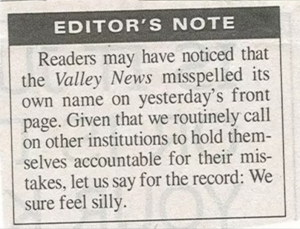
Funny correction(UPDATE: This post originally contained an error. The Fort Worth Star-Telegram, not The Kansas City Star, published the errant column I referred to below. If you spotted it and let me know, congratulations — and thanks for helping us with this project.)

The ASU News Co/Lab is deploying a “corrections tool” — a way to help journalistic corrections and major updates travel the same social media pathways as the original errors — into several newsrooms soon. This post is part of that process, as I’ll explain here.

The News Co/Lab’s Corrections Project is based on several notions: First, we believe that forthright corrections are a fundamental, essential part of journalistic transparency. Second, we can help automate the process of sending them down those social media pathways — to alert people who’d shared the original articles that there was a correction or significant update. Finally, we hope to help the news industry (and others who believe in the best journalistic principles) come up with a standard for creating and publishing corrections.

Our software developer, Ted Han, has been building the web-based corrections tool. It has two main parts:

  • Discovery — finding who shared the original.
  • Response — alerting sharers to the update, with the goal of getting them to share the update.

We’re using data generated by social media and analytics companies, bringing it into the tool to show journalists the reach of what they’ve published, and then decide which sharers of that content should get alerts when a correction is published.

How is this possible? Last year, we devised a methodology with our partners at McClatchy, a major news company. We described our approach in a blog post— our example was a column in the Fort Worth Star-Telegram, in which the columnist quoted from a news article that was based on incorrect information a government agency had provided — and how we planned to use technology to automate the hands-on process of sending out updates we used in that case.

As I said in the headline above, this post has a mistake in it. We’re asking a few of our friends to tweet about the post or retweet our own tweets. Once we’ve been informed — maybe by you? — of the mistake, I’ll correct this post here. Then I’ll use the tool to find out who shared it, and will further use it to alert several of those people who tweeted about the original.

This is a test to see how it all works, and to generate screen shots for a Users Guide we’ll give newsrooms as they test the tool.

So, if you can find the error, let me know (and include your Twitter handle so I can credit you there).