Cross-posted from my Cornerstone of Democracy newsletter…

On January 20, 2025, one of the supremely dangerous people in American history will re-occupy the White House, reclaiming all of the awesome powers of the presidency. Donald Trump and his extreme right-wing apparatchiks will issue a blizzard of executive orders, all designed to reverse decades of social, economic, environmental, and political progress – and to punish Americans who’ve had the temerity to challenge him and his cult.

That will be Day One of a saga all too likely to see the end of the brave, vital American experiment in government of the people, by the people, and for the people.

The Trump/Vance regime will be backed by a rubber-stamping right-wing Senate (maybe also the House) and Supreme Court; corporate oligarchs including fossil fuel barons and tech monopolists; right-wing media operations that use lies and propaganda to keep the cult angry and compliant; generals and police chiefs eager to round up immigrants and dissidents, and to bust heads of anyone who objects; and cadres of armed-to-the-teeth civilian brownshirts just waiting for the boss to cut the leash.

By the time they’re finished, democracy may exist in name only. We could soon be ruled by autocrats whose fascist beliefs become the ugliest realities.

I hope I am wrong about this. I would be ecstatic to be wrong. But if I’m right, or even close, we are veering into catastrophic times – into a violent, corrupt, extremist era that renders our nation unrecognizable, all too quickly, and throws the entire world into destructive chaos.

If we are facing such a nightmare, journalists will have a simple, if agonizing, choice: Acquiesce to the regime. Or join the resistance.

It makes me deeply sad to believe that most journalists will stick with what they have done for years now: business as usual. Or, I should say, malpractice as usual. The consistent failure of our top political journalists and their organizations has been deliberate failure. They have relentlessly normalized extremism, and in this election they outright refused to seriously confront the implications of vicious right-wing rule in America, much less lift a finger to prevent it.

The majority of journalists, I believe, will maintain the “neutrality” that has been so destructive to democracy. So as they sit in their above-it-all perches and watch the catastrophic whirlwind, they’ll amplify the lies and hate from Trump and his allies, downplay the havoc that results from the regime’s hard-line policies, and pretend that they are just doing their jobs as observers, assuming they’re not the ones in the firing line. That choice – and pretense – will be understandable. It will be profoundly wrong, not least because democracy and the rule of law are preconditions for freedom of the press. It will also be profoundly dishonorable.

Don’t expect any of our major media organizations to resist. There will be some brave individuals who try to keep a sense of honor even if their bosses won’t. But let’s be practical. The billionaire owners of the Washington Post and Los Angeles Times bowed ahead of time to the extremists, figuring (accurately as it turned out) that the risk of Trump’s wrath was bad for their main (i.e. not news) businesses.

We can’t talk about major media organizations without special attention to the New York Times. It is America’s most influential journalism company, and it has been the singular example of how a place teeming with talented journalists can make itself a weak-kneed supplicant to the wealth and power of the new order. No major journalism organization has shown more sympathy to extremism than the Times. No top news operation has done more to treat the most consequential election in our lifetimes as just another horse race featuring “both sides” coverage that mocks the vital role of honest journalism.

It’s telling that the Times’ editor and publisher, in recent interviews, have stressed how the Times has deployed a team to study how 21st Century autocrats in fallen democracies had brought the press to heel. Was the Times engaged in this learning process to figure out how to stop if from happening? There’s not a shred of evidence for that. Rather, as will undoubtedly become clear, the so-called “Paper of Record” was figuring out how to get cozy enough with a new Trump regime to survive and (financially) thrive.

Oh, sure, the Times editorial page will still dislike Trump (though I expect shifts in tone to appease him). Meanwhile, the rancidly terrible Times political “news” operation will continue to ever-so-politely chronicle his regime as if it was simply chronicling the winning party’s actions after a disagreement among fair, well-minded people. Worse, much of the “mainstream media” follows the lead of the Times. Unfortunately, the Times will be an adept – and historically ignominious – leader of Vichy journalism.

Some journalists, meanwhile, will choose honor. They will embrace the difficult and risky job of resisting.

They will need help. Lots of it.

They will need financial support, because corporate America will be even less interested in paying for journalism with integrity.

They will need legal support, because Trump and the new oligarchs are already adopting tactics from the playbook of dictators like Hungary’s Victor Orban – abusing the legal system, capturing the courts, and so much more that has turned a once free press there into a collection of vassals.

They will need technical support, because Trump will use the power of the state – and he will count on the willing compliance of the tech industry – to spy on, harass, and prosecute journalists and their sources. Whistleblowers will need more protection than ever, and unless journalists have the means to help provide it, daring to reveal wrongdoing from the inside will go from risky to downright dangerous.

It seems improbable, at best, that traditional media organizations will suddenly decide to find the spines they’ve put in deep storage. I’ll gratefully support the ones that do.

More likely, we’re going to need to build journalism – real journalism – up again. We can start by supporting the many smaller organizations (and individuals) that have been working tirelessly to defend democracy, human rights, the environment, and so much more. They will be under relentless pressure to shut up. Help them speak.

We will also need to build media back from the grassroots. The demise of local newspapers has given oxygen to the right-wing propagandists. We have to rebuild, one community at a time.

I’ll be doing what I can to help.

A few days ago, Dave Winer, one of the true pioneers of the Internet age, marked the beginning of his fourth decade of blogging. Just saying that is amazing.

I became a blogger because of Dave. Blogging changed — in a great way — the trajectory of my career.

Let me quote from my 2004 book, We the Media, to explain. Context: I was a columnist at the San Jose Mercury News when I got the call that changed so much. Here’s the beginning of Chapter 2, “The Read-Write Web” —

I still remember the moment I saw a big piece of the future. It was mid-1999, and Dave Winer, founder of UserLand Soft­ware, had called to say there was something I had to see.

He showed me a web page. I don’t remember what the page contained except for one button. It said, “Edit This Page”—and, for me, nothing was ever the same again.

I clicked the button. Up popped a text box containing plain text and a small amount of Hypertext Markup Language (HTML), the code that tells a browser how to display a given page. Inside the box I saw the words that had been on the page. I made a small change, clicked another button that said, “Save this page” and voila, the page was saved with the changes. The software, still in prerelease mode, turned out to be one of the earliest weblog, or blog, applications.

Winer’s company was a leader in a move that brought back to life the promise, too long unmet, that Tim Berners-Lee, inventor of the Web, had wanted from the start. Berners-Lee envisioned a read/write Web. But what had emerged in the 1990s was an essentially read-only Web on which you needed an account with an ISP (Internet service provider) to host your web site, special tools, and/or HTML expertise to create a decent site.

Writing on the Net wasn’t entirely new, of course. People had done it for years in different contexts, such as email lists, forums, and newsgroups. Wikis—sites on which anyone could edit any page—also predated weblogs, but they hadn’t gained much traction outside a small user community, in part because of the techie orientation to the software.

What Winer and the early blog pioneers had created was a breakthrough. They said the Web needed to be writeable, not just readable, and they were determined to make doing so dead simple.

Thus, the read/write Web was truly born again. We could all write, not just read, in ways never before possible. For the first time in history, at least in the developed world, anyone with a computer and Internet connection could own a press. Just about anyone could make the news.

That year included many firsts. I launched my Mercury News blog using Dave’s software. I used the same platform in a journalism course I taught that fall at the University of Hong Kong — unquestionably the debut of blogging in university coursework. And, in a visit to Beijing where I spoke at an education conference, I visibly freaked out some Chinese officials by posting a photo of them on the Web while I was speaking, noting that anyone could do that now.

During Twitter’s heyday I let my blog founder. I wish I hadn’t done that, but I let convenience and reach matter more than the open web.

Meanwhile, Dave has consistently pursued his mission over these intervening decades — creating and contributing to key technology, evangelizing open communications, and so much more. Today, he’s deeply and productively engaged in the movement to reclaim the user-controlled Internet from the centralized behemoths that have taken so much control away from us. Human communication is at stake — which means our future is at stake in all kinds of ways.

Dave’s blog is a daily testament to staying power and creativity. Kudos to the man who has done so much for so many.

Today’s Washington Post has another reminder that it’s all corruption, all the time in Trump world.

For reasons I can’t fathom, however, Big Journalism treats his serial scandals as one-offs. This piece from the Washington Post is an example of brilliant reporting with insufficient context.

It’s baffling that journalists can’t be bothered to pull it all together — to show the staggering breadth and depth of the Trump world sleaze.

Our news media notice some of the brush fires. But they never notice (or tell the rest of us) that the entire forest is ablaze.

Most journalists have an admirable instinct to be fair to the people they cover. But it often emerges as the traditional “both-sides” approach, which has become discredited in an era when one side consistently lies.

It’s especially absurd when quoting both sides means giving deceitful people a forum to change the subject and launch yet more lies.

A case in point is this, from the Washington Post. In the screenshot below is a quote from the story (labeled “analysis” — the dodge journalism uses to insert opinion into what is allegedly straight news coverage).From Washington Post opinion piece: In a text message, the Trump campaign declined to answer whether Trump truly believes his claims about electric boats and, if not, why he is continuing to repeat falsehoods about them. “The Washington Post is a pathetic institution no longer worth the paper it’s printed on and they should be embarrassed for wasting time writing a story about boats sinking when our country is sinking from Joe Biden and Kamala Harris’s failed leadership,” Trump campaign spokeswoman Karoline Leavitt wrote.

It’s important to note that the Post’s instinct in this piece is good. It wants to not just debunk one of Trump’s often-repeated fairy tales, but to explain — with facts from people who know what they’re talking about — why what he says is nonsensical garbage.

But when it asks for comment from the campaign, the Trump apparatchik responds with an attack that doesn’t even attempt to address the question, as you can see from the screnshot above.

There is zero need to publish that response verbatim.

The appropriate way to handle the Trump campaign non-response would be something like this:

“A campaign spokesperson replied to the Post’s query with an attack on the news organization. She did not address the questions we asked.”

That’s it. Don’t do stenography for liars. No one benefits, except the liar.

(h/t https://mastodon.social/@waldoj — https://mastodon.social/@waldoj/112861853467127984)

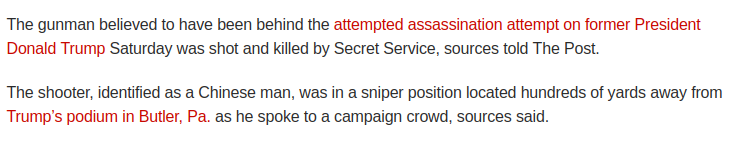
The Murdoch family’s rancid New York Post, in its early coverage of the Trump rally shooting, claimed the shooter was Chinese, citing unnamed “sources”. As we know, the shooter was a white man from Pennsylvania.

Here’s an Internet Archive link to what the Post published. Screenshot:

The story was fixed — but without, as far as I can see, any correction much less the apology that should have accompanied the revised piece.

It’s useful to keep in mind that the Murdoch empire routinely injects poison into our civic bloodstream, for power and money. It is an evil company, and no journalist with a sense of honor should work for them.

NY Times home page full of more anti-Biden stories.The screenshot above is today’s installment in the New York Times’ all-hands-on-deck campaign to get Biden to withdraw.

I want to emphasize — again — that I do not object to news organizations’ taking a stand on a matter they consider important and then pushing their view relentlessly as advocates — in news articles and commentary alike. Advocacy journalism is vital, if it’s done ethically. This isn’t even close.

Advocacy journalism, done with integrity, requires transparency. The Times keeps pretending that it’s still an impartial conveyor of what people need to know. It is not on this matter, not even close, and it refuses to be transparent — not just about doing it, but crucially who’s giving the orders and what the motivations are. Shades of the 2016 Clinton emails saga, when the Times went on a wildly dishonest binge.

Advocacy journalism also requires context. In this case, the context is stark and scary: Trump is visibly deranged, and it’s accelerating. So are his stated plans — with the backing of one of the two major political parties (including its wholly owned Supreme Court) and an army of cultists — to create a fascist America.

The Times has been, for a long time, the nation’s most important news outlet. Other journalism organizations take the Times’ lead in what national news, notably politics, that they cover and publish. The Times has disproportionate clout, and has frequently abused it.

I beg the Times to redirect its advocacy, and soon — by relentlessly making clear to its own audience, and more broadly via its influence in journalism’s broader community — the emergency it has, so far, only discussed as just one more interesting topic among many. We are on the verge of the end of the American experiment. Obsess on that, please, before it’s too late.


Photo of dark clouds at sunset

This is the first in a series of posts (cross-posted at Medium).

Dear journalists: This is your moment.

It’s your opportunity, maybe your final one, to stand proudly for reality and democracy, for freedom of expression, for human rights. To stand up as journalism’s best — think Ida B. Wells and Edward R. Murrow, among so many others — did in earlier times as they challenged a tide of political evil and helped America change its course. To reject the journalistic formulas that have made you not just ineffective, but downright helpless.

This is your chance to help America back from the brink, back to a path toward a more perfect union.

I write this during the week of July 4, when America celebrates our most significant holiday. This year, Independence Day arrives three days after a staggeringly dangerous ruling by our corrupted Supreme Court, clearing the way for presidents to be dictators.

The sliver of silver lining in the ruling was the way it clarified where we are as a nation. I hope this is also a clarifying moment for the press, even if early signs could be more encouraging.

The editorial board of the Washington Post, where the motto proclaims “Democracy dies in darkness,” published an astoundingly feckless response; yes, this is bad, the Post acknowledged, but it “isn’t the end of democracy.” Well, sure, not this minute. Just whistle past that graveyard, folks, and maybe everything will be OK.

The odds grow stronger every day that everything won’t be OK. A radical right-wing faction now fully controls one of our two major political parties and a super-majority in the Supreme Court. Its presidential candidate, a convicted criminal without an ounce of honor or conscience, has made clear his intention to be a dictator if elected. Supporting them is an army of activists who see the finish line in their long march to create an authoritarian — or outright fascist — regime that mocks the will of the majority with increasingly harsh minority rule.

If our democracy falls, one key enabler will have been the most consequential failure to date of a a vital institution do its job: journalism.

And that’s why I wish so desperately that American journalists will declare an independence of their own on July 4 2024 — casting aside traditional practices that serve, not resist, the forces of deceit, injustice, and ultimately dictatorship.

Please, journalists, declare independence from business as usual, from the counterproductive customs that have prevailed in our media even as the danger has escalated. Business as usual is outright malpractice. Stop, before it is too late.

Please be activists in protecting democracy, and by extension freedom of expression. Everyone’s fundamental rights are at stake. But understand that your special protection — freedom of the press— would be among the first on the chopping block.

This shouldn’t be a stretch. It should be core to the mission of journalism, as a matter of self-interest if nothing else.

But it is a stretch, in part because traditional journalism has imagined its role in a utopian way: as a neutral conveyor of unbiased information that the public could use to make good decisions. That sounds-reasonable approach has morphed into into a caricature.

If journalism craft imagined its job as an honorable pursuit of truth, too many purported news people have practiced something else. What has emerged, for all kinds of reasons including plain old greed, hunger for power, and simple ego, is a formula that does more to confuse and mislead the public than provide vitally needed information.

Far too much of today’s political journalism, in particular, is a toxic mess. The ingredients include — among many other things — presenting “both sides” when one is flagrantly lying; relentlessly normalizing extremism; chasing trivial shiny objects while mostly ignoring issues that matter; leaving out vital nuance or context; refusing to acknowledge critical mistakes, much less learn from them; and, particularly in the biggest and most influential news organizations, drowning much-needed humility with almost pure arrogance. And that’s what so many of the well-minded news organizations do. Meanwhile, willful misinformation is the stock and trade of countless others, large and small, even the pretense of honest journalism is a bad joke.

Obviously, not all political journalism is terrible. Scattered around in various outposts of the craft, you can find many, many examples of brilliant work from people who understand the stakes and have the resources to explain them. (I’ll highlight a bunch of them in the post that will follow this one.)

Moreover, I believe most real journalists know what a dangerously wrong turn they’ve taken. They want to do the right thing, if their bosses will only let them.

But the vital work some do is simply overwhelmed by the crap that spews every day from the dominant journalism companies and social media. And too often, depressingly, some of the same organizations that do superb work also undermine it.

A good example of this is the New York Times. It periodically offers up coverage that makes clear how much we need it, when it’s doing its job. When I recall pieces like the Times’ in-depth report on Trump’s epic tax-dodging, I’m in awe of what the organization could be if it cared enough.

Time and time again, however, the Times has served as an enabler of the people who present the greatest danger, even as it cosplays as a fearless, no-favorites arbiter by roughing up the people who are trying to stop the extremists. Remember its beyond-wretched “coverage” of the 2016 election? You should, because the Times’ obsessive pounding on the Hillary Clinton emails story was a sick parody of fair journalism. It helped elect Trump, a debacle the Times has not only refused to acknowledge but perversely still defends.

In recent months, the Times has been on a campaign to make sure Joe Biden won’t have another term in the White House. It’s engaged in what a former top newspaper editor, Melanie Sill, has aptly called an old-school newspaper crusade, in which the editorial (commentary) and news (supposedly neutral) sides of the operation act in concert to get something done. The paper pretends that it’s not on a campaign, but the reality is so blatant that no one paying the slightest bit of attention should conclude otherwise.

I’d respect the Times’ activism more if the organization was fully transparent about its motives and goals. (Giving them the benefit of many doubts, perhaps the paper’s bosses have convinced themselves that forcing Biden off the ticket is the best way to stop Trump.) Still, the fact that the Times is taking a stand — however misguided and counterproductive it may be in this case — shows that a top news organization can be activist. If only the Times saw fit to go on an old-school campaign to save democracy.*

Continue reading →

In a month from now, I’ll be leaving Arizona State University to embark on a new (for me, anyway) phase of life — first, retirement from the Walter Cronkite School of Journalism and Mass Communication, where I’ve been a member of the faculty for the past 16 years; and second, a renewed focus on civic duty.

I’ll still be plenty busy. More on that below, and in upcoming posts.

ASU has been incredibly good to me. The Cronkite School’s founding dean, Chris Callahan, hired me in 2008. He persuaded me that he and ASU’s president, Michael Crow, intended to turn the school into the finest institution of its kind. I believe it did become that. I was fortunate to be there as it happened, and am grateful to have worked with such outstanding people: practitioners, scholars, and staff — and, not least, the inspiring students.

For the past decade or so my Cronkite focus has been on media literacy. In 2017, colleague Eric Newton and I co-founded something called the News Co/Lab. We then had the immense good fortune to put the project in the hands of Kristy Roschke, who has a PhD in media literacy and is one of the most effective people I’ve ever seen in getting stuff done. Kristy spearheaded the creation of bachelors degree in Digital Media Literacy, and her many other contributions to the Cronkite School — and the vital cause of media literacy — are extraordinary.

When Chris Callahan — now the president of the University of the Pacific — first approached me about coming to ASU, I asked some friends who were familiar with higher education what they knew about the place. One of them said that the university had a president whose goal was to blow up higher education and remake it for the 21st Century. That sounded useful!

ASU used to be considered a “party school” — but today it’s a powerhouse. Crow and his colleagues deserve enormous credit for fostering that emergence. But I think their greatest achievement lives in the way they defined university’s core principles. Here’s ASU’s mission statement:

ASU is a comprehensive public research university, measured not by whom it excludes, but by whom it includes and how they succeed; advancing research and discovery of public value; and assuming fundamental responsibility for the economic, social, cultural and overall health of the communities it serves.

Please read that carefully, if you haven’t seen it before. I believe the words “…not by whom it excludes, but by whom it includes…” go to the heart of what state universities, in particular, should be but far too often are not. ASU walks the talk, and the state of Arizona will be far, far better for it as time goes on — if state and national politics permit.

There’s a very real possibility that right-wing extremists and grifters will be in charge of the federal government after this year’s elections. One of their goals is to destroy public education as we know it. Trump and his acolytes — now in control of one of America’s two major political parties and many state governments — threaten far more than public education, of course. They’re aiming to bring down democracy itself.

Which brings me to what’s next on my personal agenda. Here’s my new mission statement, if you will:

I want to help people who are working to save democracy, and by extension freedom of expression, in part by helping journalism perform its most essential role.

I am absolutely convinced that journalism’s most essential role at this critical moment goes far, far beyond what it’s doing. The status quo in political (and related) coverage consists of sporadically noting that gosh-maybe-there’s-a-problem, while sticking mostly to journalistic business as usual. The status quo is journalistic malpractice.

It would be unfair not to note that at least a few journalists are meeting the challenge (and I highlight them whenever possible). But we have to see things clearly: Most media outlets are not coming close.

And even the best work, with exceedingly few exceptions, mostly falls short of a journalistic role — albeit a discomfiting one — that feels increasingly necessary: as outright activists in defense of democracy. (I believe journalism schools should also adopt this role as part of their own missions.)

Democracy needs more than journalists to survive, and it might fall even if they do become activists in its defense. But they should understand what their role will be if it does fall: They’ll either be collaborators with dictators, or members of the resistance.

What does my new mission statement mean in practice? I have a lot of ideas, and several specific plans. I’ll be describing them in more detail in upcoming posts here and elsewhere. Meanwhile, I’m having lots of conversations with people who understand the dangerous situation we face.

I never envisioned my “retirement” going this way. Nor, however, did I imagine that I would stop working at things I care about; binge-watching and binge-reading in a recliner was never the plan, either. In the end, we do what we can, when we must, and hope it makes a difference.

Washington Post headline: "Trump says abortion should be left to states, does not endorse national limit"

It should be astonishing by now that Big Journalism keeps falling for Trump’s political scams. But when it comes to political journalists, we’re talking about people who have the attention span of gnats.

They’re still doing stenography for even the most obvious BS. Look at these Post and Times headlines, meekly reporting his patently meaningless “leave it to the states” abortion stance.

Meanwhile, our media organizations are gleefully quoting supposedly angry right-wingers who claim he betrayed them. You see, this is Conflict, at our media adore conflict!

It’s all BS. There is no “rift” between Trump and the right-wing religious extremists. Their ire is performance.

They’re some of his most important foot soldiers in the war they’re waging on civil liberties and democracy itself. They’ll be with the deceiver in chief during the campaign, and he’ll do what they demand if he gets back into the White House. This is completely obvious to everyone who is paying the slightest attention.

Trump doesn’t try to fool the voters. He lets the press do it for him.

Over at Press Watch, Dan Froomkin has posted a scathing piece about the willfully clueless New York Times Washington Bureau (and its bosses in New York). He calls it “The Washington press corps doesn’t have a freaking clue,” and he’s right on point.

It is just infuriating at this point — or “sickening,” as Dan puts it — to watch DC political journalists live down to expectations, at a time when they needed to live up to professional duties.

But they won’t. We should just face it — and move on.

I’m working on an idea that I hope will turn into something useful this year and — assuming the Trump cult doesn’t flip the switch and turn the U.S. into a dictatorship —  beyond. I’ll have more to say about it soon, but it involves the endless corruption in Trump world, which journalists treat in general like a standing joke, not the horror show it actually is.

Meanwhile, read Dan’s piece. It’s outstanding.